
Chandrashila Trek: Complete Guide to Cost, Route, Snowfall & Best Time
There’s something about a pre-dawn start that clears your head completely. No notifications, no traffic — just the crunch of your boots on gravel and a sky still deciding between night and morning. That’s what the Chandrashila Trek feels like at 4 AM when you step out of your tent in Chopta.
If you’re looking for a Himalayan trek that’s beginner-friendly, genuinely beautiful, and close enough to Delhi for a long weekend — this is the one. The route passes through Tungnath, the highest Shiva temple in the world, and ends at the Chandrashila summit with one of the most complete Himalayan panoramas you’ll find on a short trek.
We rode a scooty from Rishikesh, camped overnight, and took it one slow step at a time. Here’s everything we learned.
- Quick Trek Overview
- Why The Chandrashila Trek Is Famous
- Best Time To Visit
- Snowfall Months
- How To Reach Chopta
- Chopta: Your Base Camp
- Detailed Trek Route
- Trek Difficulty
- Cost Breakdown
- Suggested 2-Day Itinerary
- Packing List
- Weather Conditions
- Mobile Network And ATM Availability
- Safety Tips
- Sunrise At Chandrashila
- Winter Trekking Tips
- Other Places To Visit Near Chopta
- Frequently Asked Questions
- Final Thoughts
Quick Trek Overview
| Detail | Info |
|---|---|
| Trek Name | Chandrashila Trek |
| Summit Altitude | ~13,000 ft (~4,000 m) |
| Trek Distance | ~5 km one way (Chopta to Summit) |
| Difficulty | Easy to Moderate |
| Best Time | Sept–Nov (Clear Skies), Dec–Feb (Snowfall) |
| Base Camp | Chopta, Uttarakhand (~2,680 m) |
| Nearest City | Rishikesh (~220 km) |
| Trek Duration | 1 Day (5–9 Hours, Depending on Fitness) |
| Permit Required | No (as of 2024) |
| Trek Type | Day Trek or Overnight |
Why the Chandrashila Trek Is Famous
The Chandrashila Trek earns its reputation honestly. It's not the longest or most difficult Himalayan trek — but it delivers a rare combination that's hard to find elsewhere:
- Tungnath Temple — the highest Shiva temple in the world (3,680 m) sits directly on the trail. You pass through it before reaching the summit. The stone structure against the Himalayan backdrop is unlike anything else.
- 360° Summit Views — on a clear day from Chandrashila (~13,000 ft), you can see Nanda Devi, Trishul, Kedar Dome, Chaukhamba, and Bandarpoonch all in one sweep.
- Accessible from Delhi — one of the most practical snowfall treks near Delhi; doable in a long weekend.
- No Technical Skills Needed — no ropes, no crampons required outside of deep winter. Suitable for first-timers.
- Chopta Itself — the base camp is a quiet meadow settlement in the Kedarnath Wildlife Sanctuary. Green in summer, white in winter. Very few tourists compared to busier Himalayan circuits.
Doing Chopta + Tungnath + Chandrashila together makes this one of the most complete short treks in Uttarakhand. Each stage feels different, and none of it feels like filler.
Best Time to Visit — Season by Season
March – April (Spring)
Snow is melting on the upper trail. Rhododendrons bloom in shades of red and pink through the forest section. Trails can be muddy and wet, but the colour and freshness make it worthwhile. Moderate crowds. Good for photography.
May – June (Early Summer)
Trails are fully open and accessible. Meadows are green, temperatures are comfortable, and the morning air is cool enough to make the climb pleasant. This is when we trekked — 10 June 2024 — and it was genuinely comfortable. No snow, clear skies at dawn, and easy trail conditions. A great time for first-timers.
July – August (Monsoon)
Best avoided. Landslide risk is real on the mountain roads, visibility drops significantly on the trail, and the Kedarnath region sees some of the heaviest rain in Uttarakhand. Not worth the risk.
September – November ⭐ (Best for Clear Views)
The golden window. Post-monsoon skies are crystal clear, and the Himalayan panorama from the summit is at its most dramatic. Temperatures are comfortable during the day and crisp at night. This is the most recommended window for first-timers who want the best possible views without winter conditions.
December – February ❄️ (Best for Snowfall)
Chopta transforms completely under heavy snowfall. The trek feels entirely different — silent, white, and more demanding. Temperatures drop to -10°C or below at night. Tungnath temple is closed. But if snowfall is what you're after, this is the season. Go prepared.
Snowfall Months
Peak snowfall at Chandrashila runs from December through February. Snow can arrive as early as late November on the upper sections and sometimes lingers into March. The January window typically sees the deepest snowfall and the most dramatic trail conditions.
How to Reach Chopta (From Delhi / Rishikesh / Haridwar)
The Route
Delhi → Haridwar / Rishikesh (by bus or train, ~5–6 hours) → Chopta (~220 km from Rishikesh, 7–8 hours by road)
Key waypoints from Rishikesh: Devprayag → Rudraprayag → Ukhimath → Chopta
Transport Options from Rishikesh
| Option | Approx. Cost | Notes |
|---|---|---|
| Rented Scooty / Bike | ₹700–₹1,000/day | Adventurous, scenic, budget-friendly |
| Shared Taxi | ₹600–₹900/seat | Ukhimath, then local transport |
| Private Cab | ₹4,000–₹6,000 one way | Comfortable, direct |
| State Bus (GMOU) | ₹200–₹400 | Cheapest, but slow and infrequent |
Chopta: Your Base Camp
Chopta sits at around 2,680 m in the Kedarnath Wildlife Sanctuary. It's a small settlement — a few camps, some basic shops, and a trailhead that leads straight up to Tungnath. No ATMs, limited phone signal, and limited electricity and charging options in many camps.
It's quiet in a way that feels deliberate. Not underdeveloped — just genuinely off the tourist circuit compared to most Himalayan base camps.
Stay Options
| Option | Price Range | Notes |
|---|---|---|
| Tent Camps | ₹400–₹800/person | Most common, warm bedding, basic meals |
| Forest Rest House | ₹800–₹1,500 | Book well in advance |
| Local Guesthouses | ₹600–₹1,200 | A few options near the trailhead |
We stayed at a tent camp. Before leaving at 4 AM, we left our heavy bags at the camp and only carried a small daypack with water, snacks, and a first-aid kit. There's absolutely no reason to lug a full bag up the mountain.
Carry a fully charged powerbank. Electricity and charging options are limited at Chopta. Your phone drains faster in the cold, and you'll want it for photos, navigation, and emergencies. Don't assume you can charge at the camp.
Detailed Trek Route: Chopta to Chandrashila
The entire route is around 5 km one way — from the Chopta meadow up through forest, past Tungnath Temple, and on to the Chandrashila summit. It splits naturally into two stages, each with a distinct character.
Stage 1 — Chopta to Tungnath (3.5 km | ~1.5–2 Hours)
The trail begins right at the Chopta meadow. Within the first few minutes you enter a dense mixed forest of oak and rhododendron. The path is paved with stone steps for most of this section — well-maintained and easy to follow even in low light at 4 AM.
As you climb, the trees gradually thin and the views start opening up on both sides. The air gets crisper, the light gets better, and somewhere before you see it — you'll hear the faint sound of temple bells.
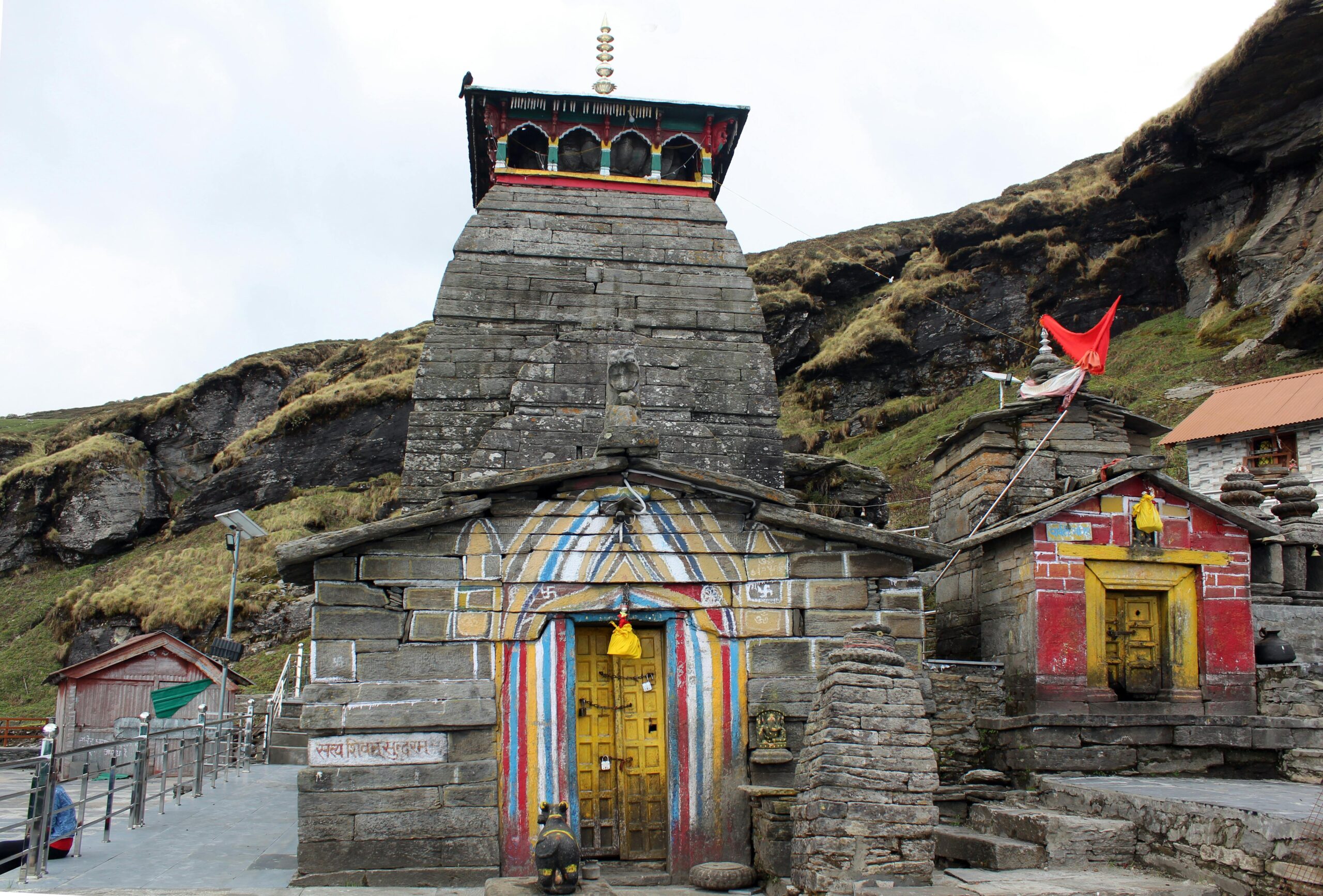
Tungnath Temple at 3,680 m is the highest Shiva temple in the world. Whether or not you're religious, it's a striking place — an ancient stone structure at altitude, with Himalayan peaks behind it and prayer flags moving in the wind. Sit for a few minutes. Have chai if the stalls are open (they usually are from May to October). Take it in before pushing on to the summit.
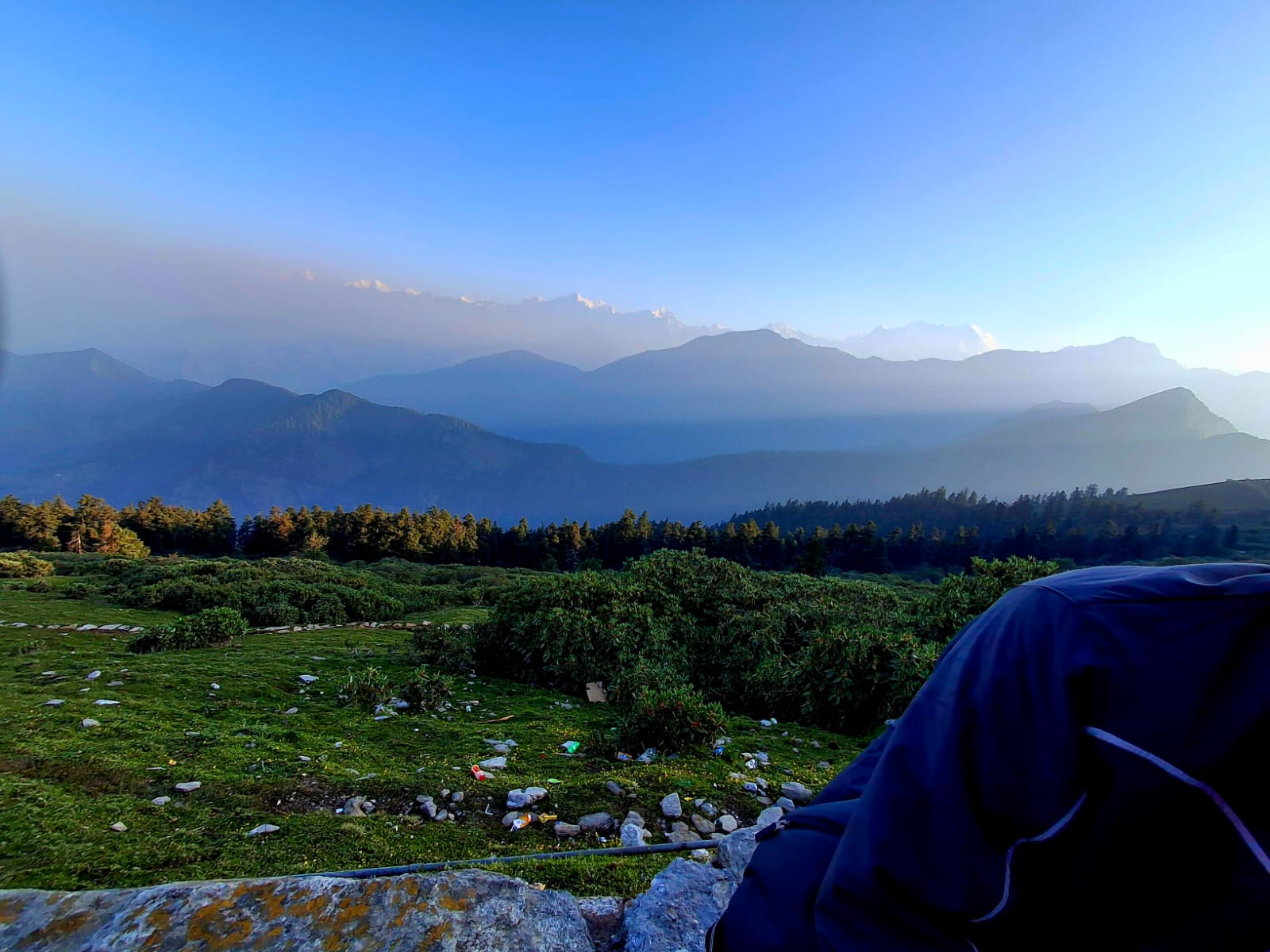
A short break on the trail to Tungnath — cold air, tired legs, and endless mountain layers in the distance.
Stage 2 — Tungnath to Chandrashila Summit (1.5 km | ~1–1.5 Hours)
This is where the trek starts feeling properly demanding. After Tungnath,, the trail becomes steeper, rougher, and much more consistent on the legs. The stone steps gradually disappear and the climb feels noticeably harder.
Take this section slowly. Short breaks genuinely help, especially if this is your first Himalayan trek. Thankfully, the views become better and better as you gain elevation, so stopping never really feels frustrating.
At the summit (~13,000 ft / ~4,000 m), there’s a small Chandrashila temple surrounded by panoramic Himalayan views. On a clear day, peaks like Nanda Devi, Trishul, Chaukhamba, Kedarnath Dome, and Bandarpoonch are visible across the horizon.
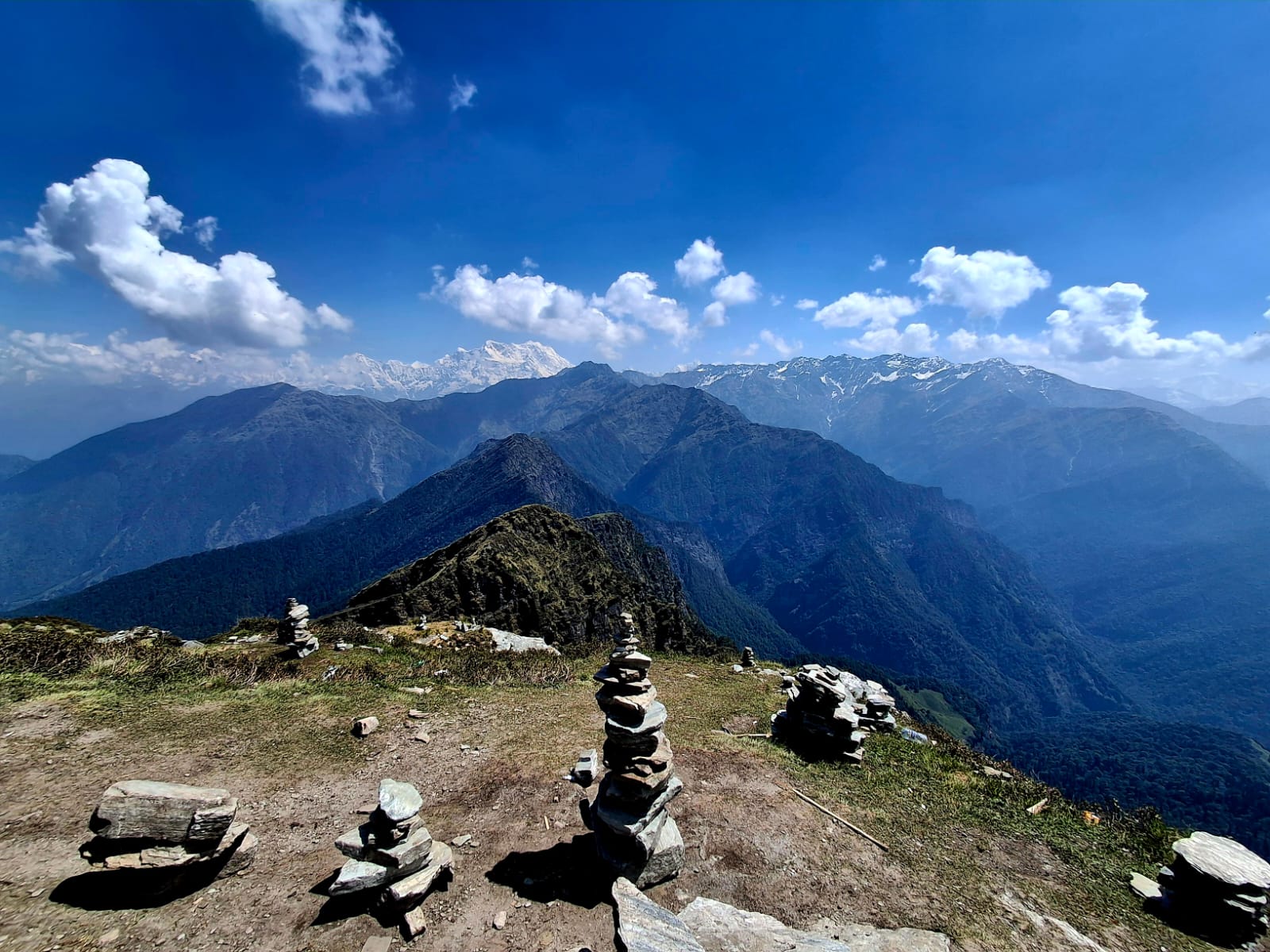
The view from Chandrashila summit after the final climb — endless Himalayan layers, cold wind, and the kind of silence that makes the entire trek feel worth it.
Trek Difficulty
Quick Answer:
The Chandrashila Trek is classified as Easy to Moderate. No technical climbing, no ropes, and no prior trekking experience are needed. But altitude affects your stamina in ways flat-ground exercise doesn’t prepare you for. First-time trekkers consistently find it harder than expected.
If this is your first trek, the 5 km distance will feel much longer than it sounds. Altitude reduces your effective stamina — even a pace that feels easy at sea level will feel slow and effortful above 3,000 m. That’s normal. Take breaks without guilt, drink water steadily, and don’t try to keep up with faster trekkers.
We’d suggest at least 2–3 weeks of consistent cardio — walking, jogging, stairs, or incline walking — before attempting the trek. Not because it’s dangerous, but because you’ll enjoy the experience far more if you’re not exhausted during the final kilometre.
Cost Breakdown — Budget Travel from Delhi
| Expense | Approximate Cost |
|---|---|
| Delhi to Rishikesh (Bus) | ₹300–₹500 |
| Scooty Rental in Rishikesh | ₹700–₹1,000/day |
| Fuel (Rishikesh–Chopta Return) |
₹900–₹1,500
(Fill at Ukhimath. Emergency roadside fuel costs much more.) |
| Camp Stay in Chopta (1 Night) | ₹500–₹800/person |
| Meals at Chopta | ₹150–₹300/meal |
| Trek Entry Fee | ₹0 (As of 2024) |
| Miscellaneous (Snacks, Chai, Medicines) | ₹200–₹400 |
| Total per Person (Budget) | ~₹3,000–₹4,500 |
This is one of the genuinely affordable Himalayan treks accessible from Delhi. The scooty route keeps transport costs low while making the journey itself part of the experience. If you take a private cab instead, expect your budget to increase by roughly ₹2,000–₹3,000 per person.
Suggested 2-Day Itinerary
Day 1 — Delhi / Rishikesh to Chopta
- 6:00–7:00 AM: Depart Delhi by early bus or train to Rishikesh / Haridwar.
- 11:00 AM–12:00 PM: Arrive Rishikesh. Rent scooty. Fuel up fully here.
- 12:30 PM: Depart Rishikesh. Brief stop at Devprayag confluence — worth 20 minutes.
- 3:00 PM: Stop at Rudraprayag for a meal and short rest.
- 4:30–5:30 PM: Arrive Ukhimath. Fill fuel again here — this is your last reliable pump.
- 6:30–7:00 PM: Arrive Chopta. Check into camp, eat a proper dinner, and sleep early.
Day 2 — Chandrashila Trek + Return
- 2:30–4:00 AM: Begin trek from Chopta (timing depends on your fitness and sunrise goals).
- 5:30–7:00 AM: Reach Tungnath. Rest, pray if you wish, and have something warm.
- 7:00–9:00 AM: Summit Chandrashila (~13,000 ft). Take in the panorama.
- 9:00–11:00 AM: Descend back to Chopta at your own pace.
- 11:30 AM: Back at camp. Collect bags and eat a hot meal.
- 1:00–2:00 PM: Consider a side visit — Deoria Tal or Kartik Swami if time permits.
- Evening: Begin return to Rishikesh. Overnight stay in Rishikesh if needed.
Packing List
Essentials (All Seasons)
- Layered Clothing — base layer, fleece mid-layer, and windproof outer jacket
- Trekking Shoes with ankle support — avoid running shoes and sneakers
- Sunscreen SPF 50+ — UV intensity at altitude is significantly stronger than at sea level
- Sunglasses — essential in both summer and snow conditions
- Powerbank (Fully Charged) — electricity and charging options are limited at Chopta
- Water Bottle — carry at least 1.5 litres; refill options on the trail are limited
- Energy Snacks — dry fruits, chocolate, trail mix, glucose biscuits
- Basic Medicines — tablets for headaches, body pain, muscle soreness, ORS sachets, and personal medication
- Headlamp or Torch — absolutely essential for pre-dawn starts
- Light Daypack — leave your larger bag at camp
- Cash — there are no ATMs near Chopta; withdraw enough in Rishikesh
Winter Additions (Dec–Feb)
- Woollen thermals (top and bottom)
- Snow gaiters
- Woollen gloves and balaclava
- Microspikes or crampons (especially above Tungnath)
- Hand warmers
- Insulated water bottle (regular bottles may freeze)
Weather Conditions at Chandrashila
| Month | Day Temp | Night Temp | Conditions |
|---|---|---|---|
| March–April | 8–15°C | 0–5°C | Partly cloudy, melting snow |
| May–June | 12–20°C | 5–10°C | Clear and pleasant |
| July–August | 10–15°C | 5–8°C | Rainy, foggy, avoid |
| September–November | 10–18°C | 0–5°C | Clear skies, best views |
| December–February | -2 to 5°C | -10 to -2°C | Heavy snowfall |
For live weather updates before your trek, check the India Meteorological Department .
Mobile Network & ATM Availability
- BSNL has the best coverage across most of the route and at Chopta. If you don’t have a BSNL SIM, consider keeping one as a backup.
- Airtel and Jio work in patches — reliable in larger towns like Ukhimath, spotty near Chopta, and essentially absent above Tungnath.
- At the summit, expect no signal regardless of operator. Download offline maps (Maps.me works well) before you start.
- No ATMs exist near Chopta. Nearest ones are in Ukhimath (~25 km away). Withdraw from Rishikesh.
Safety Tips
- Share your plan before leaving — tell someone your route, camp location, and expected return time. Share your live location if possible.
- Ask locals when in doubt — camp owners, shopkeepers, and fellow trekkers are genuinely helpful with route conditions and weather updates. In our experience, they’re your best source of real, ground-level information on the mountain.
- Don’t trek alone in winter — the trail can disappear under snow and disorientation happens faster than you'd expect.
- Watch for altitude symptoms — severe headache, nausea, and disorientation are signs to stop and descend. Don’t push through these.
- Stay on the marked trail — especially above Tungnath. Shortcuts often aren’t.
- Carry out your waste — Chopta and the trail are relatively clean. Keep them that way.
- Turn back in lightning — if a storm rolls in while you're on the exposed ridge above Tungnath, get down immediately.
The Sunrise Experience at Chandrashila
If you do make it to the summit before dawn, it's one of those rare moments that justifies every early alarm and every aching step to get there.
The sky shifts through shades of deep navy, violet, and then gold. The snowcapped peaks catch the first light before the valleys do. For a few minutes, everything is quiet except the wind. Then the sun clears the horizon and the entire Himalayan arc comes alive in orange and white.
Most trekkers begin between 2:30–4:00 AM depending on their fitness level and weather conditions. Work backwards from the local sunrise time for your travel date — you'll need roughly 4–6 hours to reach the summit at an average pace.
If sunrise at the exact summit isn't possible, don't be disappointed. The post-sunrise golden hour — the light on the peaks between 6 and 8 AM — is equally stunning. We reached the top around 9–10 AM and still had a clear, brilliant view. The mountain doesn't only reward the fastest.
Winter Trekking Tips (December – February)
Winter Chandrashila is a completely different trek. The trail disappears under snow, Tungnath closes for the season, and the cold becomes genuinely serious. But the silence, the white landscape, and the empty mountain create an atmosphere that's difficult to describe unless you've experienced it yourself.
A few things matter much more in winter:
- Hire a local guide — the trail may be invisible under snow. In winter, a guide isn't a luxury. It's the sensible choice.
- Start early — overnight snow hardens into a firmer surface by morning, making footing easier than soft afternoon snow.
- Layer properly — you can always remove layers, but you can’t add what you didn’t pack. Thermals under everything.
- Microspikes above Tungnath — mandatory. The upper section can become genuinely icy.
- Build in extra time — everything takes longer in winter. Don’t rush.
- Stay hydrated — cold air is deceptive. You lose moisture faster than you'd expect, even without visible sweating.
- Tungnath is closed — the temple follows the Char Dham calendar and shuts for winter. Respect this and focus on the summit.
Beyond the Trek: Places Worth Visiting Near Chopta
Don’t leave the moment you're back at camp. The wider Chopta region rewards slow travel, and there are several places nearby that most trekkers skip entirely because they're in a hurry to get back to the highway.
- Deoria Tal — a high-altitude lake (~2,438 m) with mirror reflections of the Chaukhamba peaks on calm mornings. About a 3 km trek from Sari village, which is ~15 km from Chopta. Don’t miss this.
- Kartik Swami Temple — another hilltop temple with excellent 360° Himalayan views, far less crowded than Tungnath. Short drive from Chopta, then a 30-minute climb.
- Kanchula Korak Musk Deer Sanctuary — you'll pass through this on the road. If you see deer near the road, stop.
- Ukhimath Temple — an important pilgrimage site and the winter seat of the Kedarnath deity. Worth a stop on the way back.
Frequently Asked Questions
Is the Chandrashila Trek Suitable for Beginners?
Yes — it's classified Easy to Moderate and requires no technical skills. First-timers should be prepared for the trek to feel longer than expected. Build some basic fitness (walking, jogging) before you go.
Can I Do the Chandrashila Trek in One Day from Rishikesh?
Technically possible but exhausting. You'd need to drive 220 km, trek 10 km round-trip, and drive back — all in one day. A night at Chopta makes the experience far better and safer.
Do I Need a Guide for the Chandrashila Trek?
No guide is required in summer — the trail is well-marked and easy to follow. In winter, when snow can obscure the path, a local guide is strongly recommended.
What Is the Best Time for Snowfall at Chandrashila?
December to February, with January usually seeing the heaviest snowfall. Snow can arrive in late November and sometimes lingers into March on the upper sections.
Are There Food Stalls or Tea Shops on the Trek?
Yes, in the summer months (May–October) there are a few tea and snack stalls near Tungnath. In winter they're closed — carry all your food and water from Chopta.
Should I Avoid Trekking During Monsoon?
Yes — landslide risk on the approach roads is real, and the Kedarnath region sees heavy rainfall in July–August. Trail visibility also drops significantly. Not recommended.
How Far Is Chandrashila from Delhi?
Roughly 450–480 km by road. The Rishikesh to Chopta leg alone is about 220 km.
Is There an Entry Fee for the Chandrashila Trek?
As of June 2024, there is no entry fee. This may change — verify locally before you go.
Is Tungnath Temple Open All Year?
No. It follows the Char Dham calendar and is typically open from May to November. It closes for the winter months.
Do I Need to Be Religious to Enjoy This Trek?
Not at all. The historical and architectural significance of Tungnath stands independent of faith, and the natural landscape of Chandrashila is its own reward.
Final Thoughts
The Chandrashila Trek won't push you to your absolute limits. That's not what it's for. What it will do is give you the Himalayas in a form that's accessible, unhurried, and quietly overwhelming — a summit view that most people never earn, reachable in a weekend from Delhi.
We rode a scooty from Rishikesh, ran low on fuel, left our bags at camp, started before dawn, missed the sunrise, and still found the whole thing absolutely worth it. No guide, no package, no prior Himalayan experience. Just common sense, a charged powerbank, basic medicines, and the good sense to ask the locals when we didn't know.
That's really all it takes.
If you're planning your first Himalayan trek, start here. Train a little, leave early, be honest about your pace, and don't miss Deoria Tal on the way back.
Have questions about the Chandrashila Trek? Drop them in the comments — we try to respond to everything.
If this guide helped, share it with someone planning their first trek.
— TravelCoda · Trek Guides · Last Updated: June 2026